Labyrinth of Fir and Fern

labyrinthI hiked ten miles during a recent camping trip. It was hot and I was tired (and thirsty – I didn’t realize there wouldn’t be water available at the highway trailheads we passed) but I felt deep satisfaction in knowing I could complete a long day’s hike. 

The next day, Tali and I took a two mile stroll through the woods, following a path that twisted and turned and led ever upward. As I turned around to retrace my steps, I realized I was traveling a labyrinthian trail. I stopped.

“Divine – whatever you are, whoever you are, IF you are – show yourself. Not so that I will believe, because I don’t think you ever obscure yourself. I think – no, I believe – you are visible, if I can only have eyes to see.”

I looked around. I saw firs, ferns, tiny maples. I remembered the majesty of the aspen grove we walked through the day before. I remembered when, long ago, I received these words: Look at nature. Look at the trees, the hills. Wrap yourself in them, because it is my love extruded into the world.

My deity is not a god of deserts, but rather, one of forests and hills, of vineyards and fields. So long have I searched for home, but in that moment, I realized I’ve never been homeless. I am a child of the Willamette valley. I carry it within me, and in so doing, also hold the divine, who is visible within and without.

We Ask for Healing

by Dinah Roe Kendall

The Story: Jairus was the head of a synagogue, and his daughter was ill.  He begged Jesus to heal his daughter.  As they traveled to Jairus’ house, word came that the daughter had died. Jesus continued to the house anyway, and raised the little girl to life.

Jairus hoped for a simple healing, but what he received was resurrection. This is true for us, as well. We ask for healing in so many areas of our lives – our physical selves, our emotional selves, our spiritual selves. The Divine is just as generous with us as They were with Jairus. We, too, receive resurrection. We are changed, we are reborn!

Enough!

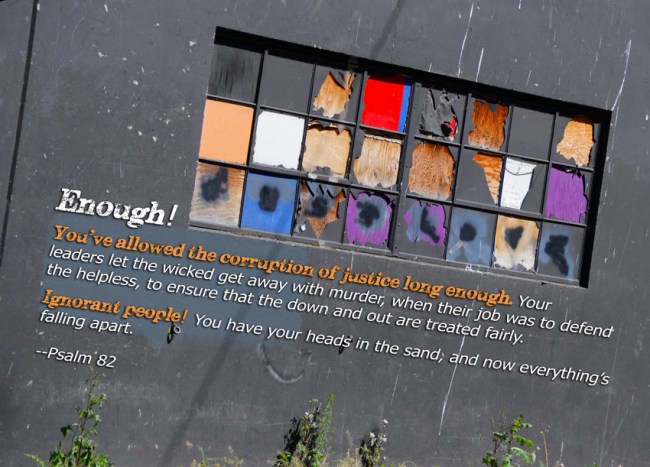
enoughEnough! You’ve allowed the corruption of justice long enough. You’ve feigned helplessness or turned your back as your leaders let the wicked get away with murder. Their job was to defend the helpless, to make sure that the underprivileged and the down-and-out are treated fairly. Their job – and yours – is to stand up for the powerless, and to rescue them from those who exploit them. Ignorant people! You have your heads in the sand. You haven’t a clue what’s going on, and now everything’s falling apart. – paraphrase of Psalm 82

I’m incensed at those who mouth the words of our rich political and business leaders: “The unemployed are lazy. They don’t work hard enough. There are plenty of jobs. They just don’t try.”

I want to shout, “Quit drinking the kool-aid!  (Or tea, in this case.)  Open your eyes and see what’s going on!”

But then I look at myself. What am I doing to change our society, our political structure? Wringing my hands makes me exactly as effective as those whose blindness infuriates me. In fact, isn’t my inaction even more egregious than their ignorance? Because I DO see what’s going on.

What can I – and any individual – do? I mean, like, immediately? I can:

  1. Refuse to patronize the businesses of large employers who pay their workers less than a full-time, living wage.
  2. Move my money from a bank to a credit union.
  3. Purchase products that are fairly traded. (My responsibility for my fellow humans doesn’t end at my country’s border.)
  4. Campaign for living wages for all. Poverty would end tomorrow if we had national minimum income and a higher minimum wage.
  5. Buy less. Need less. Give more.

The current oligarchy will collapse in a month if we refuse to participate in the economics of our current era. It’s time to get our heads out of the sand. This isn’t just a political problem, it’s a spiritual one, and the psalm is clear. If we continue to stand (purposefully or through inaction) on the side of those who profit from exploiting others, we stand against God. 


Acceptance

_DSF3062Acceptance is simply the recognition that things have changed and will never be what they were before. This is how we find the strength to journey on. We accept the truth of what happened. We accept our hurt, our anguish, our sadness, our anger, our shame, and in doing so we accept our own vulnerability.  – Desmond & Mpho Tutu, The Forgiveness Challenge.

It’s been almost 12 years since my husband Lee died. But only in recent years have I accepted that I will never be the same as before. In many respects, that is a very GOOD thing – I am more easy-going (scary thought, huh? What WAS she like before!), more driven to artistic expression, more in awe of the world around me.

I am also more fragile, more easily frustrated, more easily broken. I am still learning to be gentle with myself, and to safeguard myself against those who are strident.

It’s a spiritual journey, walking the path of my broken, stumbling, dancing, laughing, crying, fragile self. As I learn to accept the truth of my journey, I grow stronger. And, I hope, more content – with myself, with the world, and with the path.

To Begin to Forgive

I started Desmond Tutu’s 30 day forgiveness challenge this week. It must be rocking my subconscious boat, because since I’ve begun, I’ve been easily angered, swiftly upset, quick to tears and cranky words.

I think that means the challenge is doing the work it needs to do. At least, I hope it does. That it doesn’t mean, five days in, I’m already failing.

I know that, despite the hastily aroused emotions, I’ve been feeling more like I’m being led, and less like I’m adrift without sail or rudder. The seas are choppy but not too stormy: drizzle, not deluge.

Is this how forgiveness begins?


If you’d like to join the challenge, click here: Tutu Global Forgiveness Challenge

What the Heck is Triduum?

KONICA MINOLTA DIGITAL CAMERALent is an endurance course, filled with hills & dips, with boulders that block & pebbles that turn the foot, and with the occasional breath-taking view. The last three days, Triduum, are the cruelest of all, for the path climbs straight up, straining our spiritual muscles to the breaking point.

It begins with Maundy Thursday, best known as ‘foot washing day’. Someone on a forum asked, “It makes me really uncomfortable. What’s up with foot washing?” Well, it’s about remembering that the Christ path is first and foremost about serving, especially those whose feet are dirty. It’s about taking our shoes off and realizing that our feet are dirty, too. It’s about washing others’ feet without judging. It’s about being humble, and letting someone else wash your feet – without worrying about whether or not you’re being judged.

And really, it’s not about feet at all. It’s the intimacy we’re uncomfortable with, isn’t it? But Jesus called us to be personal, to be intimate, to be truly loving with one another. We need to have MORE foot washing, to break through our barriers. Because if such an innocuous thing makes us uncomfortable, we can be sure we’ve placed even higher blockades on more important matters.

Good Friday reminds us that neither government nor society are just arbiters. It shoves into our faces the truth that soldiers, left alone, may torture and mock. That government convicts innocent people. Then and now, we should be horrified when anyone’s dignity is cast aside.

Jesus’ death was not ordained of God, not part of some convoluted plan to save us from a self-bound deity. His death was man-made, because then and now, we will go to any lengths to silence those who pull us from our comfortable delusions. Good Friday gives us the opportunity to contemplate our chains – and the chains of others.

On Holy Saturday, we sit in stillness with Our Lady of Solitude, grieving that which is gone. This is the hardest day- to just sit in our discomfort. If you’re like me, you don’t want to endure, you want to cure. But unless we understand the causes of our pain, we don’t correct, we only mask.

So, we sit silently with all who grieve, all who have lost love, homes, jobs, dignity, hope. We must understand their pain, because Easter resurrection will come for them only if we, the hands and hearts of Christ, bring it.

Finally, FINALLY, after this three day period that lasts forever, we reach the resurrection summit. Our Triduum tears have cleared our eyes, and we can see for miles.

We Are Who We Are

This is JUST what I needed to hear today. It’s a quote from a book, but I converted it to poem format, because…well, because that’s how it spoke to my heart.

rain


Maybe one day we’ll grow weary of whining 
and instead celebrate 
the rain, 
the manna, 
the half-filled glass of water, 
the little gifts from heaven that make each day bearable. 
 
Instead of cloaking ourselves in the armor of pessimism, 
maybe we’ll concede that 
we are who we are: 
capricious, 
unfortune, 
wonderful, 
delicate, 
alive.
 
Forgiven.
 
— Mark Collins in On the Road to Emmaus
 

Collins’ book is available here: On the Road to Emmaus

No Sneaking Out to the Field

wheat field

Forgive. We know this word. We recite it in the Lord’s Prayer, “forgive us our sin, as we forgive…” We hear it in Peter’s generous offer to forgive his enemies 7 times – and Jesus’ ridiculously abundant response: “No, 70 times 7.”

This word (the Greek word is aphete) is also used in a place we do not expect. It’s watered down by most translators to permit, perhaps because, like Peter, they feel permit is generous enough.

Remember the parable of the good seed and the weeds? It goes like this:

A farmer sows wheat seed. In the night, an enemy sows weed seed in the same field. His crop starts to grow, and so do the weeds. His employees are dismayed, and ask if they should go pull out the weeds.

The farmer responds, “No. If you pull up the weeds, you’ll pull up the wheat right along with it. Permit it to grow alongside until the harvest, and then we’ll separate it.”

  • As an aside: this is terrible practical advice. Anyone who’s planted a garden knows you have to keep it weed-free if you want a harvest. Clearly, it isn’t meant as farming instruction. Though, as literally as some take other parts of the Bible, I wonder that they don’t insist upon this, as well.

Back to the parable. We have understood the parable to mean that error (sin, evil) will be with us until the end, when God will separate good from error. We can – and should – try to remove it, but we won’t be totally successful until God returns.

Except that this isn’t what the parable instructs – AT ALL. First of all, the word we translate permit is aphete. That means, we aren’t supposed to permit the error among us, the error around us, the error within us. We’re supposed to forgive it. To EMBRACE it. Because we’re supposed to understand that when we try to remove it from our midst, we damage each other and ourselves.

Wha-what? No. That can’t be right. God cannot be telling us to allow, embrace, forgive the bad/wrong/evil in our midst. What about accountability? Restitution?

Ummm. Over 2000 years ago, a shadow fell across the ground in a place called Golgotha. It still falls across this page, across my/your life, across the world. This cross-shaped shadow reminds us that sacrifical forgiveness and godly love have been demonstrated to be the Way, and that we are called to live the same Way.

Without sneaking out to the field to pull ‘just a few’ weeds.

Sticks and Stones

cherie sad thoughtsHealing a hurting world is the motto of Episcopal Relief & Development. I’m following their daily Lenten devotions, and today’s meditation hit me square between the eyes. You see, I believe that what we think and say affects the world around us – it changes the ‘vibration’, if you will. So my Lenten focus this year centers around my thoughts and my words. 

We’re still early into the season, but I have to tell you, I’m pretty discouraged.  I think of myself as a generally positive person, but you wouldn’t know it by what I verbalize silently and aloud. Ouch. I had no idea how much negativity I spew into the universe. It seems I can’t finish a thought without horrifying myself.

But that’s what Lent is about, isn’t it? To see ourselves. To hear ourselves. To discipline ourselves, not just for a season, but for life.

Today’s devotion addresses the harm – or the good – that result from our utterances. I’ve copied it, below.  May the words bring both instruction and hope to my heart – and yours, as well. (To learn more about Episcopal Relief & Development, click this link: Episcopal Relief.)

Sticks and Stones

Let no evil talk come out of your mouths, but only what is useful for building up, as there is need, so that your words may give grace to those who hear.  –Ephesians 4:29

What we say matters. Indeed, it matters a great deal. The childhood adage about sticks and stones –“but words will never hurt me”– is courageous but often untrue. After all, words can and do hurt. Our words can steal a person’s joy and murder their spirit, destroy their reputation and lead them to resentment or envy. In the same way, words can and do make us feel valued. “I love you.” “I forgive you.” “I am so very proud of you.” These are building blocks for helping construct a healthy and happy life.

The fact is that great power is unleashed, for good or for bad, for building up or for tearing down, every time we choose to open our mouths. It is little wonder, then, that James urges followers of Christ to be “quick to listen, slow to speak, and slow to anger” (James 1:19). How utterly countercultural this is today, as we tune in to just about any talk show program and hear talking heads carp at each other with no one truly listening to the other.

On the cross, when he understandably could have cursed his tormentors or insulted his fellow prisoners, Jesus instead chose to speak words of forgiveness on behalf of those who knew not what they did and to speak words of comfort to a criminal who had little hope. May I choose this day to offer forgiveness and hope and value to those I encounter — through my words as well as my deeds. May my words build up, always.

— C. K. (Chuck) Robertson

Wisdom of the Dalai Lama

dalai lama“As long as space remains and as long as sentient beings remain, until then may I, too, remain and help dispel the misery of the world.”

The Dalai Lama closed this morning’s conversation at the Washington National Cathedral with this prayer. I wrote down some of his statements (as best I could) – and I present them here without commentary.

  • Genuine harmony must come from the heart. Too often, we put on the externals of a pleasant face and appropriate gestures, but true harmony must be rooted at the heart level.
  • All religions carry the same message, the same practice, the practice of love. That includes forgiveness and tolerance. Anger and hatred comes from a religion with a self-centered attitude. Also greed, jealousy and mistrust. All religions teach contentment & simplicity.
  • Buddha’s own mind was not very certain. He would tell one group this, and another one that. He deliberately created confusion among his followers, because it is necessary to have different practices, different beliefs. Seven billion people need a variety of methods to promote love and compassion.
  • As a child carries some of her father’s genes, so too each creature carries the spark of God.
  • Buddhists believe in no creator, no causality. They believe in oneself as creator, through our experiences and actions. (Karma.) If we do good action, we benefit. If we do bad action, there are negative consequences. If we do not behave well, no one can save us. It is a great responsibility.
  • Even among believers (there are one billion who believe in no religion in the world) there are mischevious believers, with a lack of conviction about moral ethics. Moral ethics are very important for happiness and peace in ourselves, our community and the world.
  • We need an approach to moral ethics that is acceptable to everybody, including the non-believer.
  • Science tells us a happy mind is important for a happy body. We must cultivate a happy mind. We have too much stress, too much worry. Those who receive maximum affection as a child are happy inside. Those who do not are filled with fear and mistrust. So we have to extend to each other maximum love, to give trust to those who fear.
  • If certain religious teachings go against scientific findings, we have the right to reject those teachings.
  • Western knowledge of psychology is at a kindergarten level compared to Indian psychology.
  • We must always look at the human level. This is the fundamental level. We are all human. We tend to be too concerned about the secondary level – position, education, faith, nationality, etc. When relating to others, we must relate at the human level. Sometimes we must access the secondary level to make a tough decision, to access the resources there.
  • We must have sincere motivation and the object of our dream must be realistic and noble. Our approach must also be realistic. If there’s too much desire in our motivation, then we can’t see reality.
  • Anger is attachment, and it is destructive because then emotion comes and we can’t see reality.
  • We need constant effort to promote religious harmony.