A Place to Wander, Not Possess

dancing pilgrim“Pilgrimage is a journey back. It can give us new eyes – the eyes of children…children’s eyes see color and significance where we see only grays and emptiness. Pilgrims are dancing, delighting children.” – Charles Foster, The Sacred Journey

There are pragmatists in the world who look upon my mystic perspective with disdain. “It’s not REAL,” they sniff.

That always makes me cock my head and furrow my brow. Real? How did they get sidetracked onto ‘real’? You see, that’s not the point. Mystic literature and perspectives aren’t about reality, they’re about truth.

I know that many religious types in the West also confuse reality with truth, going so far as to insist that truth-tales be viewed as scientific reality. But constraining a story to its reality (or lack thereof) requires us to overlook much of its truth.

Let me repeat: there’s a difference between what is real and what is true.

‘Real’ changes as quickly as our scientific advancements. What we know to be real one day is considered bunk the next. Remember ether? How about continental drift? A steady-state universe? (Actually, that one still has adherents. And with the advent of Rainbow Universe theory, the Big Bang may go from truth to discard. But I digress.) The point is, reality, or our understanding of it, changes.

Truth, on the other hand, remains amazingly constant across time.Truth cuts through grey reality, bursting into, around and through it with technicolor clarity. Let me be a dancing child, not a snorting skeptic.

As Foster points out, pilgrimage allows us to shed our color-blind perspective and see the world as colorful and meaning-imbued. More about pilgrimage next time, but for this week, practice seeing with pilgrim eyes. Look upon your surroundings as a place to wander, not possess.

The Place of Our Resurrection

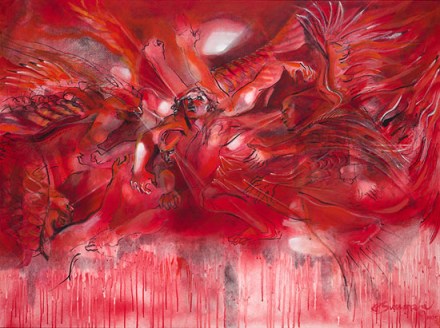
http://www.tenwomengallery.com/index.php/montana-ave-store/70-karyn-raz
Art by: Karyn Raz


As you know (if you’ve been following my blog) I’ve been reading David Adam’s work,  A Desert in the Ocean. This little book is dense with Spirit inspiration.

Today, I was struck by the third-century Celtic perspective about resurrection. They didn’t focus on a post-death experience. Instead, from their perspective, the place of their resurrection was when they found their life’s purpose and entered into it.

It is an affirmation of my belief that we are called to the place where our greatest passions meet the world’s greatest needs. In that crossroads lies our vocation, our joy, and according to the Celts, our resurrection.


The Place of My Resurrection

Holy Awen
breathe me
to the place of my resurrection.

Hang me in the crossroads
a gangly, grinning scarecrow
to draw the volt of raptors
whose dirty talons
claw
infecting healthy souls

with fear
of failure
of sorrow
of pain
of poverty
of sickness
of death.

Let the disease-ridden wake
land on me
for I’ve faced this flock
and their beaks have lost their pluck.

Let them land
for they will not feast
upon the chortling mad woman
hanging on her cross.

We Don’t Do Karma

Jacob Wrestles the Angel, by Arthur Sussman http://www.arthursussmangallery.com/
Jacob Wrestles the Angel, by Arthur Sussman
http://www.arthursussmangallery.com/

It’s been more than a month since I last posted. I moved both home and office in September and October. I experienced financial tribulation. (I’m always so optimistic about how much it will cost to move. This is one scenario where pessimism might a better choice. Although then I might never go anywhere at all.) While I reconnected with some of my loved ones, I said goodbye to others. I traveled and I worked. Stress abounded.

My prayer practice was irregular. It would have been easier to maintain a center if I’d been more disciplined about altar time. Wish I could really LEARN that lesson. Still, in the midst of the maelstrom, I found myself, like Jacob, on the road wrestling with God. I emerged not with a limp, but with a renewed commitment to pursue ordained ministry. Why? Because I was reminded that my life centers around my desire to reach out to others and show them the Divine in the universe and in themselves.

After searching my heart and soul, looking at other denominations and other faiths, I am certain of my call. I am ridiculously in love with with this guy who walked the earth 2000 years ago. Call me polyamorous, because I want to share him, not in a “have-you-found-Jesus-as-your-personal-savior” way, but in a “OMG-did-you-hear-what-he-said-isn’t-he-dreamy” way. Ewwww. Saccharine. I know. But there it is.

It makes me sad that because of well-meaning but theologically incorrect Christians, many people are turned off even by the mention of his name. That’s heartbreaking. It’s like being turned off by the mention of Buddha or Mahatma. Like them, Jesus had game-changing ideas.

His best one is forgiveness. In Episcopal and Lutheran churches, we do this ritual every Sunday. Put simply, it’s called DO-OVER! (AKA confession and forgiveness.) You see, guilt and shame cripple us, prevent us from being our best selves. But Christianity (another touchy word) says, “You’re forgiven. Let it go. Move on.” It’s a do-over. Christians don’t do karma. We do love and forgiveness. That’s radical.

Speaking of love, Jesus  had some pretty interesting ideas there,too. “I say to you, love your enemies and pray for those who harass you…just as your heavenly Parent shows love to everyone, so must you.” When someone irritates me, hurts my feelings, doesn’t appreciate me – my response can be, not anger or irritation, but love. Jesus says, “Someone’s hurt you? Love anyway. Love especially.” How is that even possible? But when I take his words to heart, my life is transformed.

I’m sometimes asked, “How can you possibly believe that? And why would you want to?” My response is that my life is better for believing.  If you’ve followed my blog, you know that I’ve talked about what I DON’T believe with regards to traditional Christianity. I’d been trying to decide if this disqualified me from pursuing the priesthood. I’ve been reminded that it’s not my decision, so I’ve placed the call and I’ve committed to preparing the paperwork. We’ll see what happens next.

Current Canon for a Contemporary World

adam“For life to be lived to the full it has to be adventurous. I believe that God calls us to adventure.”

So begins David Adam’s book A Desert in the Ocean – God’s Call to Adventurous Living. *  It heads my list of new canon, because virtually every sentence impacts me, makes me want to run out my front door – to act and to be.

Adam posits that adventure does not take us out of the world, but more deeply into it, and not just into the physical world, but into the spiritual as well. For the Celtic view is that there are not two separate worlds – the mystic & the mundane – instead, heaven and earth are inextricably interwoven, so that exploring one leads us naturally into the other.

Adam states “A slight shift in where we stand and the world beyond reveals itself to us.” I’ve found that to be true. I have seen ‘the other side’ – usually only glimpses, but sometimes a clear, if fleeting, view. I can’t describe it, of course, not directly, because human language is inadequate. It’s not about the input of eyes, ears, nose or hands. It’s about what the heart sees. What the soul sees. What that part of us that extrudes beyond the mere physical experiences and explores.

I find myself speaking in metaphor or in parable, trying to describe what I’ve seen. Jesus did the same. Now I understand that he wasn’t trying to be abstruse. He was doing his best to communicate as clearly as he could. Where direct description finds itself mute, poetry and other lyrical language may successfully speak.

Adam’s book is a call to action. It even includes exercises at the end of each chapter to help us to open ourselves to God’s call to life adventurous. It exhorts, it inspires, it pushes us in the direction of the divine. The loopy script of Spirit clearly flows from Adam’s pen. Just like all Scripture, it is inspired and inspiring, current canon for a contemporary world.

* Its American tagline reads: The Spiritual Journey according to Brendan the Navigator. I got my copy at Iona Island in Scotland.

Directed!

walkThe ELCA (Evangelical Lutheran Church in America) has a new presiding bishop – and for the first time, a female was elected.  (The Episcopal church elected their first female presiding Bishop in 2009, my Episcopal sistren are quick to point out.) I have more to say about gender and religion (perhaps my next blog?) but today, my thoughts are swirling in a different direction.

In an interview with Time Magazine, Elizabeth Eaton (the new ELCA presiding bishop) was asked:

I hear you have a spiritual director. What is your process of spiritual direction, and how has it shaped you?

“There are people now who are spiritual and not religious. I would characterize myself as religious but not spiritual. I am a faithful person, but taking a closer look at my relationship with God in a more intentional way was something that gave me the willies sometimes. So I thought, By golly, if I really believe what I preach, then I can’t do this on my own. If everyone of us depends utterly on God, maybe I need to start finding a way to have a discussion about that with God, and I thought, I might need someone to help me dial into the God frequency.

..I contacted <a spiritual director> and she said, “O.K. I want to be clear: I am not a psychologist, I am not a therapist, all I am is someone who can be your companion while you are having your conversation with God, and I will eavesdrop on your conversation and help you to stay honest in that.” We have been doing that for the past year or so, and it has made a huge difference.”‘

I LOVE the response given by her spiritual director! That’s exactly it. As a holy listener, I’m given permission to eavesdrop on conversations with God, to provide accountability, and sometimes, direction. But mostly, I’m there to be a companion, because it’s lonely to go it alone.

Curious about holy listening/spiritual direction?  Wholly Listening

Holy Wanderer – the canon of the Journey

_DSC5832“I’ve been on many journeys.” – Paul of Tarsus, writing to the church at Corinth in autumn 55 CE.

I don’t know how many times I’ve begun my altar time with deep prayer and/or a card reading, then opened my daily reading book (currently Celtic Daily Prayer) to find that the scripture reading affirms and further enlightens the initial whisper of Spirit. It happened again today.

First, I meditated on two cards drawn from Wisdom of the Crone: Magick and Journey. They instructed me that my ‘glimpses’ are true visions of the Divine, and that my life path will include exciting journeys. They further noted me that ‘home’ is within me as I travel grounded in Spirit.

Then I turned to Celtic Daily Prayer and discovered that today’s readings centered around journey: specifically, the physical journeys that lead us to spiritual awakening.

I’ve always considered myself Peregrini – a spiritual wanderer. My life choices haven’t given me opportunity to indulge in much physical wandering, but Spirit assures me this is coming, and soon. So it’s no surprise that as I gathered books from my shelf inspire me, many revolve around travel. They include:

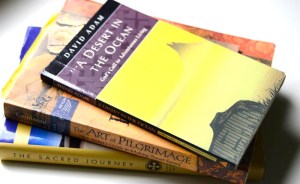
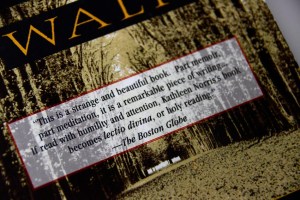
The Sacred Journey, The Art of Pilgrimage, A Desert in the Ocean, The Book of Creation, The Cloister Walk._DSC5830

I’ll talk about each of these books in subsequent posts, making the case for their inclusion in canon.  Then I’ll give you my fiction list. (Fiction? Divinely inspired story telling? Yep. Just like many of the stories in the Bible and other holy writ.)

If you’re feeling the tug of Spirit, read these books. Walk the path of the Peregrini with me.

Sacred Scripture – Inspired Word or Blasphemy?

_DSC5692What makes a written work ‘sacred’, and why are certain works elevated above others?

Please bear with my scholarly tone for the next few paragraphs. Eventually, I’ll make a case for ongoing revelation as opposed to set scripture (see – there’s a payoff coming!) But first, I need to set the ‘sacred’ scene. Here we go!

Most religious traditions have a fixed and unalterable set of written work that is ‘official’ or canon (i.e., sacred.) All subsequent writing is considered supplementary and of lesser authority.

The reason for canon is to unite followers around a common understanding or set of rules, thus reducing the chance of misinterpreting or altering the understanding of their Divine’s communication. It also enables the community to pass on their beliefs to subsequent generations.

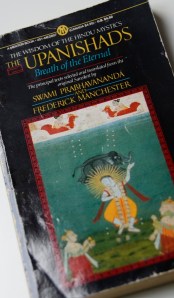
For example, the Vedas, Brahmanas, Aranyakas and Upanishads are Hindu canon. Called Shruti, meaning ‘heard’, they are understood to be received directly from the Divine. Everything after is called Smriti,’remembered’- contemplations upon Shruti._DSC5694

Theravada, or Way of the Elders, is Buddhist canon, and Mahayana, or Greater Vehicle, is the inspirational supplement.

Judaism’s canon, the Tanach, is supplemented by the Talmud and the Midraash.  Christians accept the Tanach (the Old Testament) as canon, and also include the New Testament. Catholic Christians add writings (Apocrypha) that are considered merely inspirational by Jews and Protestant Christians. These gathered writings are known as The Bible.

Canon, then, is an expression of the conviction that Divinity speaks to a given group only for a discrete time. During this period, revelation is received, and then held as God’s final word. The problem is, this assumes a group’s behaviors and understandings – their culture – does not change through generations.

And this assumption runs contrary to history. Cultural norms DO change, and dramatically. For example, Judeo-Christian ideas about equality, about slavery, about consequences for trangression – even about what constitutes transgression – are markedly different than they were 4000, 2000, 1000 or even 100 years ago. How can a religion remain relevant in the face of canonical rigidity?

_DSC5695Christians today are caught in this dilemma. In light of canon that teaches that men should not shave and women should not speak, that slavery is acceptable and despots are God’s judgement on the faithful, Christians today tend toward one of two perspectives:

1) Evangelicals, who accept canon as the unalterable Word of God, but focus heavily on certain passages and ignore others. This pick-and-choose fundamentalism requires mighty mental machinations to navigate.

2) Mainliners, who consider canon as a reflection of the time in which it is written, but continue to incorporate outmoded interpretations into their worship. (I.e., virgin birth, original sin, human sacrifice.)

Both approaches are problematic – in the exact same way. Because new revelation is not allowed, Christians are forced to shoehorn antiquated perceptions of the Divine into their modern understanding.

It is error to relegate God’s voice to the ancient past. Divine revelation in one moment becomes blasphemy in the next if people hold rigidly to it rather than embracing ever-unfolding epiphanies. Today’s movement of Spirit is not supplementary, it is primary. It is as canonical as were the transcendent whispers in the ears of our ancient mothers and fathers.

In my next post, I’ll talk about candidates for a current canon. Post your ideas here, too!

A Disturbance in the Force

taylor 10The past month has been wonderful. My youngest son’s wedding brought visits from my oldest son, my daughter’s family, and many others. Because we live so far apart, it’s rare for us to gather, and what joy when we do!

However, the disturbance in my typical schedule has caused sleep difficulties. I also find myself maintaining a more intense baseline emotional state. For example, I find myself weeping more easily, both in joy and in frustration. I feel a little off-kilter, even in the happiest moments. And then I feel like a failure, spiritually speaking, because if I’m truly traveling the path of the ephemeral, I should be able to maintain a physical, emotional and spiritual balance at all times, right?

The truth is, it’s very difficult to maintain an mystic focus while immersed in the mundane. Surely that’s why many who dedicate their lives to spiritual pursuits live in seclusion or in religious communities. If nuns, monks, desert Mothers and Fathers require a life apart from the mainstream, I think I shouldn’t beat myself up too badly when I fail to maintain a perpetually centered perspective in the midst of the maelstrom of the dailies.

Having said that, I think I can do better. You see, I have a tendency to abandon grounding physical, emotional and spiritual practices when life gets busy. I forget to take exercise, altar, and down times. That’s the exact opposite of what I should do!

So, lesson learned. Sleep. Pray. Exercise. Meditate. Be. No matter how joyful the occasion. No matter how busy the day. Spirit will thank me, I will thank me, and the people around me will thank me. Awen.

Light Bulb Jokes

light bulbNo, really.  Here are some of my favorites:

How many religious liberals does it take to change a light bulb? At least ten, to hold a debate on whether or not the light bulb exists. Even if they agree upon the existence of the light bulb, they may not change it, to keep from alienating those who might use other forms of light.

How many Episcopalians does it take to change a light bulb? Ten. One to call the electrician, and nine to say how much they liked the old one better.

How many United Methodists does it take to change a light bulb? Eleven. One to change the light bulb. And ten more to organize a covered dish supper that will follow the changing of the bulb service.

How many Lutherans does it take to change a light bulb?  We don’t know yet. They have appointed a committee to study the issue and report back at their next meeting.

How many United Church of Christ members does it take to change a light bulb? We choose not to make a statement either in favor of or against the need for a light bulb. However, if in your own journey, you have found that a light bulb works for you, that is fine. You are invited to write a poem or compose a modern dance about your personal relationship to your light bulb and present it next month at our annual light bulb Sunday service, in which we will explore a number of light bulb traditions, including incandescent, fluorescent, three-way, long-lived, and tinted; all of which are equally valid paths to luminescence through Jesus Christ.

Look for the Barn Doors

theworldismineI attended a memorial service yesterday for a man of passion and integrity. Bill was born in India. His first religion was Sikhism, which believes in one God. When he moved to America at age 20, he encountered Christianity. It made no sense to him. Why would God become a man?

On Christmas Eve 1964, he heard Paul Harvey on the radio. Harvey related the story of a man in the Midwest. Let’s call him John. John was a respected man, a good farmer, husband, father. Like Bill (and many of the rest of us) John just couldn’t wrap his head around the idea of  divinity wrapped in human flesh. One winter Sunday, he sent his family off to church and settled into his chair.

Suddenly there was a crash. He ran outside, and saw that a small bird had gotten cold and disoriented in the snow (winter in the Midwest, remember) and crashed into his living room picture window. The bird was huddled, shivering.

John ran to his barn, opened the doors wide, and tried to shepherd the bird inside, where it would be safe and could recover. The bird didn’t understand, and flew this way and that to avoid him. John even tried using a broom to shoo the bird into the warm shelter, but the bird didn’t understand and grew ever more frantic.

“If only I could become a bird for just a minute,” thought John. “I could talk to him and lead him to safety.”

Just then, in the distance, the church bells rang. And John understood.

– – – – – – – – – –

So did Bill. The next day, he joined the Lutheran church and became a powerful advocate for the hungry and needy in his community. He will be missed.

Christ and other bodhisatvas didn’t come to tell us about a warm, safe haven in some future incarnation. They come to lead us to it in this life, to show us that our wings will carry us there now.

Like Bill, my life was enlarged when I chose to accept the unexplainable, to believe that divinity dwelt among us – that it still dwells among us, within us, within me. Rather than flying in fear, I look for the barn doors. And I try to show others the spark of divinity within themselves, so they can find the warm barn, too.